

Black girl/White girl
Black Girl/White Girl by Joyce Carol Oates
Harper Collins, 2006
 Voici un livre qui ne m'a pas énormément plu (oui, c'est une litote ^ㅠ^) ; le style de Joyce Carol Oates ne m'a touchée ni émotionnellement (sauf à certains moments de ma lecture), ni esthétiquement. J'ai eu l'impression d'être en face d'une piètre tentative de 'tolstoïsme" : J. C. Oates veut nous parler d'une époque, d'une société, et utilise pour cela le récit du quotidien d'une jeune pensionnaire ; mais contrairement aux romans de Tolstoï, celui de J. C. Oates a fini par m'ennuyer à plusieurs reprises, et le mystère qui règne autour de certains personnages les a rendus presque creux à mes yeux (en tout cas aucun d'eux n'a vraiment attisé ma sympathie ou ma curiosité).
Pourtant, ce livre aborde la question raciale au Etats-Unis de manière assez orginale - un peu brutale (il s'agit quand même de la déchéance et de la mort d'une jeune fille noire) - et il regorge de références historiques très intéressantes (le KKK, les Black Panthers, la Vénus hottentote...). C'est par ailleurs aussi - surtout ? - l'histoire d"une famille qui va à sa perte, dont chaque membre semble tirer l'autre vers le bas.
En somme, il s'agit d'un livre intéressant dans le fond, mais dont la forme m'a tout à fait déplu. Pour moi, J. C. Oates n'a pas réussi à s'emparer de ce sujet, bien qu'elle ait choisi un angle tout à fait intéressant pour traiter la question. C'est bien dommage.
Résumé du livre (Harper Collins)
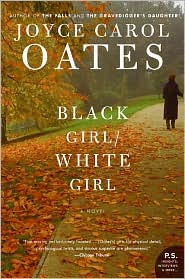 In 1975 Genna Hewett-Meade's college roommate died a mysterious, violent death partway through their freshman year. Minette Swift had been assertive, fiercely individualistic, and one of the few black girls at their exclusive, "enlightened" college—and Genna, daughter of a prominent civil defense lawyer, felt duty-bound to protect her at all costs. But fifteen years later, while reconstructing Minette's tragic death, Genna is forced to painfully confront her own past life and identity...and her deepest beliefs about social obligation in a morally gray world.
Black Girl / White Girl is a searing double portrait of race and civil rights in post–Vietnam America, captured by one of the most important literary voices of our time.
Interview de l'auteure
Q: What drew you to examine race relations in the post-Vietnam milieu of a women's liberal arts college?
A: Like Genna, I have long been haunted by certain memories having to do with intense relationships, particularly interracial relationships, of that turbulent era. Primarily, Black Girl/White Girl is the story of two very different, yet somehow "fated" girls; for Genna, her "friendship" with Minette is the most haunting of her life, though it is one-sided and ends in tragedy.
Q: Why did you decide to implicate Minette Swift in some of the racist harassment she suffers?
A: Partly, I was moved to dramatize an actual sequence of events that took place in a college dormitory in the 1970s, not at any university at which I've taught but in the near vicinity. Minette has complex, largely unconscious motives for much of her behavior that might seem irrational to others.
Q: To what extent is Genna's revelation of her father's complicity in the death of a security guard a response to her own sense of culpability in Minette's death?
A: Genna is that rare individual, a "good" person; she has internalized a genuine moral code, and is appalled by her father's seeming involvement in the death of an innocent man. Yet it is only under emotional duress that she exposes him. Her sense of guilt in regard to Minette is less clear: all along, Genna has been shielding Minette from a confrontation with the truth out of her timidity and fear of provoking anger in Minette. To the very end, perhaps naively, Genna yearns for Minette's friendship.
Q: Is the "difficult" persona of Minette Swift a reaction to the isolation she feels as one of the few black students at Schuyler, or is it inherent to her character?
A: To Genna, Minette is fascinating because she is the unknowable, elusive, seemingly self-reliant Other. Genna seems to have little awareness of Minette as a lonely, insecure, deeply frustrated young woman who has grown up in a sheltered environment where she has felt entitled and superior as the daughter of a renowned Negro minister. (Though there is a side to Minette that is genuinely religious, even humble.)
Q: Others have described Black Girl/White Girl as a coming-of-age novel. To what extent do you agree?
A: Yes, Black Girl/White Girl might be described as a "coming-of-age" novel, at least for the survivor Genna. It is also intended as a comment on race relations in America more generally: we are "roommates" with one another, but how well do we know one another?
A propos de l'auteure
 Joyce Carol Oates is a recipient of the National Book Award and the PEN/Malamud Award for Excellence in Short Fiction. She has written some of the most enduring fiction of our time, including the national bestsellers We Were the Mulvaneys and Blonde (a finalist for the National Book Award and the Pulitzer Prize), and the New York Times bestsellers The Falls (winner of the 2005 Prix Femina Etranger) and The Gravedigger’s Daughter. She is the Roger S. Berlind Distinguished Professor of the Humanities at Princeton University and has been a member of the American Academy of Arts and Letters since 1978. In 2003 she received the Common Wealth Award for Distinguished Service in Literature and The Kenyon Review Award for Literary Achievement, and in 2006 she received the Chicago Tribune Lifetime Achievement Award.
Source : http://www.harpercollins.com/author/microsite/About.aspx?authorid=7275
A propos de l'éditeur
 HarperCollins Publishers is one of the world’s leading English-language publishers. Headquartered in New York, the company is a subsidiary of News Corporation. The house of Mark Twain, the Brontë sisters, Thackeray, Dickens, John F. Kennedy, Martin Luther King Jr., Maurice Sendak, Shel Silverstein, and Margaret Wise Brown, HarperCollins was founded in New York City in 1817 as J. and J. Harper, later Harper & Brothers, by James and John Harper. In 1987, as Harper & Row, it was acquired by News Corporation. The worldwide book group was formed following News Corporation’s 1990 acquisition of the British publisher William Collins & Sons. Founded in 1819, William Collins & Sons published a range of Bibles, atlases, dictionaries, and reissued classics, expanding over the years to include legendary authors, such as H. G. Wells, Agatha Christie, J. R. R. Tolkien, and C. S. Lewis. HarperCollins has publishing groups in the United States, Canada, the United Kingdom, Australia/New Zealand, and India.
Today, HarperCollins is a broad-based publisher with strengths in literary and commercial fiction, business books, children’s books, cookbooks, and mystery, romance, reference, religious, and spiritual books. Consistently at the forefront of innovation and technological advancement, HarperCollins is the first publisher to digitize its content and create a global digital warehouse to protect the rights of its authors, meet consumer demand, and generate additional business opportunities.
Soure : http://www.harpercollins.com/footer/companyProfile.aspx